The Terracotta Army
ChinaThe Terracotta Army
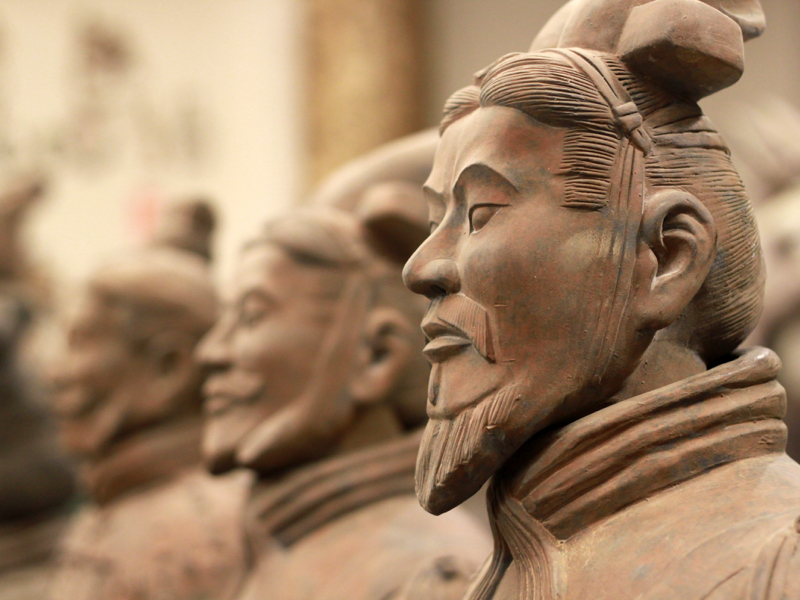
Located in the surrounding plains of the city of Xi’an, China, these impressive figures date back from the last third century BCE. They are a collection of terracotta sculptures depicting the armies of Qin Shu Huang, who was the first emperor of China. They were made as funerary statues and were buried with the emperor to protect him in his afterlife.
There are 3 pits that contain the life-sized statues of the Terracotta Army, with the heights varying according to their role. There are more than 8,000 soldiers, 130 chariots with 520 horses and 150 cavalry horses. As well as the military figures, acrobats, strongmen and musicians have also been found, who are said to have been buried with the emperor to provide him entertainment.
It is said that originally the figures would have been painted in bright colours, such as reds, pinks, greens, blues, whites and purples but over the years the paint has either faded or flaked off. After the excavation of the Army, the painted surfaces that were present on some figures began to flake and fade. The lacquer covering the paint can curl in 15 seconds once exposed to Xi’ans dry air and can then flake off within 4 minutes.
The figures weren’t discovered until 1974, by a local farmer in the Lintong District in Xi’an, who was digging a water well around 1.5km east of the Qin Emperors tomb. They are now a UNESCO World Heritage Site.