
The Wildlife in Costa Rica
Costa Rica is home to more than 500,000 species of wildlife and 300,000 species of insect, which represents 4% of the total species in the world, making Costa Rica one of the 20 countries with the highest biodiversity in the world.Sloth
There are 6 sloth species in the world, with two of these species living in Costa Rica. These are Hoffman’s Two-toed sloth and Brown-throated sloth. The Hoffman’s Two-toes sloth, is a nocturnal animal and is more difficult to spot. If you are luckily enough to spot one during the day, they will probably be napping. The Brown-throated sloth, which is a three-toed sloth is more common to see and they are more active. Sloths are renowned for bring incredibly slow, which is due to their digestion system, as the how the slowest out of any mammal. It can take them two weeks to fully digest a meal. To try to save their energy, the sloths do less rather than eat more and spend up to 20 hours a day sleeping. Their diet consists of mostly leaves, branches, buds and the occasional insect. A sloth is a relative to anteaters and armadillos, and typically live up to 12 years in the wild.

Puma
To spot a Puma in Costa Rica, it is best to head to Tenorio, Miravalles Volcano National Park, Corcovado National Park, Monteverde Cloud Forest Reserve, Santa Rosa National Park and Sirena Biological Station. These magnificent cats are born blind and don’t open their eyes until they are two weeks old. Young cubs are born with spots to help camouflage them from potential threats and overtime they fade. A normal diet for a Puma consists of capybara, agoutis, pacas, coatis, olingos, raccoons, porcupines, opossums, hares and small reptiles. They grow to a length of 60-90cms and weigh up to 100kgs, and their tails are between 63-95cm length. Females are typically smaller than males, however the size of a Puma is different depending on their geographic region.

Capuchin Monkey
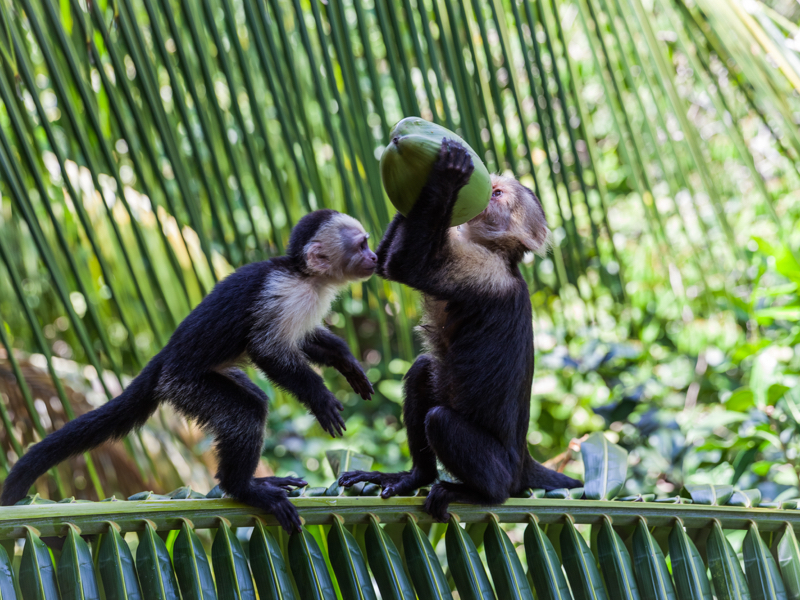
Capuchin monkeys are found in wet lowland forests on the Caribbean coast of Costa Rica and Panama, and in the deciduous dry forest on the Pacific coast, such as in Santa Rosa Nacional Park, La Selva, Corcovado National Park, San Jose, San Vito and Monteverde. These monkeys are noticeable as they have a black body with a white face and black cap on their head. They are normally found in groups, with the average size being around 15. There is normally one adult male who leads the group. Female Capuchin Monkeys have one baby every 1-2 years and the babies will cling to their mum for the first 5-6 months of their life. These monkeys can live in habitats up to 1,500m in elevation, and their movements are vital for the vegetation of the forests, as they are so active throughout the treetops, they help to disperse seeds, and prune branches, as well as eating insects that would damage plants. Capuchins are insectivorous, with a diet consisting of insects, fruit, flowers, invertebrates, with the insects they eat consisting of butterfly larvae, ants and grasshoppers. Adults are generally 2.5 to 3.5kgs with males being a little larger than females.
Red Eyed Tree Frog
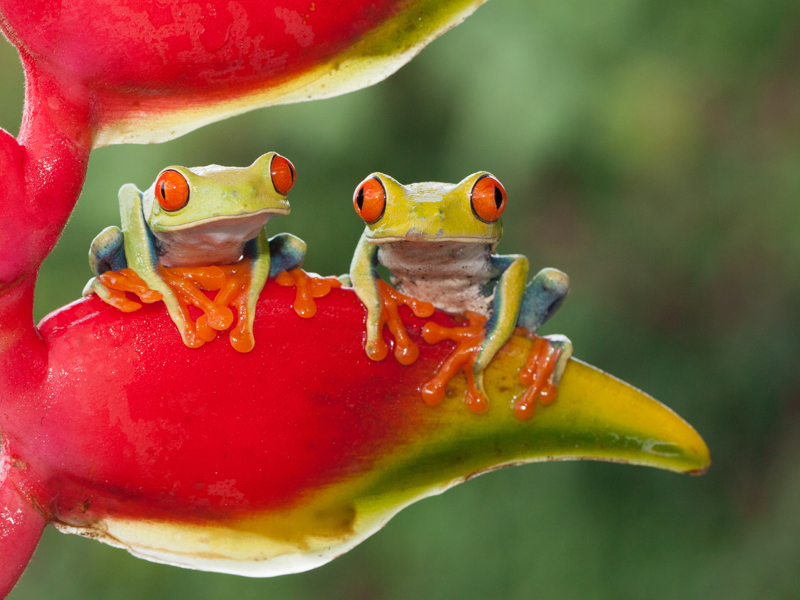
The Red Eyed Tree Frog lives in the trees of the Costa Rican Rain Forest. The clue is in the title, but the most prominent feature of these tree frogs is their eyes. They have very narrow pupils that run vertically which make for a unique appearance. Most of their bodies are bright green, however you can also see stripes of tallow and blue along its sides which its feet often red or orange. They are most commonly found in the national parks of Monteverde Cloud forest, Tortuguero National Park and Manuel Antonio National Park, and will spend most of their years in the upper parts of the trees and not come to the ground until they reach the age of maturity. The frogs have adapted well to their lifestyle which is evident in their feet. In addition to their webbed feet, they also have tiny suction cups on the bottom of their feet, which allows the frogs to cling to leaves without fear of falling to the ground. They also have long sticky tongues which make it easier to catch food. Most tree frogs eat insects such as moths and crickets, however some may also eat smaller frogs.
Toucans
Toucans are some of the most exotic looking birds on the planet, with 6 species that can be found in Costa Rica.
Keel-Billed Toucan
It is a larger toucan that has a Rainbow coloured bill and is most commonly found in Rincon de la Veija, Santa Elena town near Monteverde, Arenal and Puerto Viejo de Talamanca.
Black-mandibled Toucan
This is the other large toucan in Costa Rica, and it is slightly larger than the Keel-Billed, and is found on the Osa Peninsula, Dominical and Sarapiqui area.
Collared Aracari
A small toucan, which is found in forests and gardens in Arenal and Sarapiqui.
Fiery-billed Aracari
This toucan is found in the lowlands and foothills from Carara south to the border.
Emerald (blue-throated) Toucanet
It is a little toucan, found in the Monteverde area, most commonly at the Cinchona Hummingbird Café.
Yellow-eared Toucanet
A shy bird, which makes it very difficult to see, however the best place to spot them is at sites such as Rara Avis, Braulio Carillo National Park and Arenal.
These beautiful birds eat almost anything they can find, but most commonly fruiting trees, small animals and bird nests.
